
"coffee farming in Haiti"
300 article(s) found

Rich flavor and mild taste Haiti: Port-au-Prince Coffee
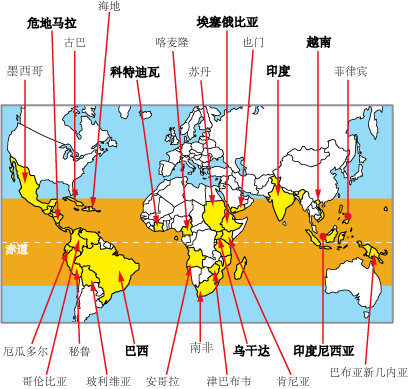
In 1725, Haiti officially began to grow coffee in the north, and now produces and exports about 600000 bags of coffee a year. Unfortunately, even in the final selection stage, Haiti does not distinguish between the quality of coffee beans on each farm. Coffee beans are mixed with the good and the bad. General Haitian coffee, mainly exported to European countries, led by France, used to make blends

Introduction to coffee growing area and growing environment in Port-au-Prince, Haiti
Most of the coffee produced in Haiti is grown in a purely natural state, which is not intentional but the result of material shortages because coffee farmers are too poor to buy fungicides, insecticides and fertilizers. On the contrary, this makes the coffee produced in Haiti the most natural and pollution-free. Haitian coffee has full grains, rich flavor, medium to low acidity and mild taste.
Flavor and taste characteristics of Haitian coffee in Port-au-Prince, Haiti. Blue Haitian coffee mountainous country Haiti
Haiti: Port-au-Prince coffee flavor taste characteristics: rich flavor, mild taste. Haiti, located in the western part of the island of Hispaniola in the Lobi Sea, covers an area of about 27800 square kilometers. Haiti means a mountainous country in indigenous languages. This mountainous country is also the most disaster-prone region on earth. It has been in the midst of war and poverty, and is the most material-poor country in the world.

Rich flavor, mild taste, Port-au-Prince, Haiti coffee
Most of the coffee produced in Haiti is grown in a purely natural state, which is not intentional but the result of material shortages because coffee farmers are too poor to buy fungicides, insecticides and fertilizers. On the contrary, this makes the coffee produced in Haiti the most natural and pollution-free. Haitian coffee has full granules, rich flavor, medium to low acidity and warm taste.
Introduction to the flavor and taste characteristics and roasting degree of Asian coffee beans in Port-au-Prince, Haiti
Flavor and taste characteristics: rich flavor, mild taste. Haiti, located in the western part of the island of Hispaniola in the Lobi Sea, covers an area of about 27800 square kilometers. Haiti means a mountainous country in indigenous languages. This mountainous country is also the most disaster-prone region on earth, it has been in the midst of war and poverty, and it is one of the most material-poor countries in the world. Even so,

The Blue Mountains of Cuba? The Blue Mountains of Haiti? What other knockoffs do you have for Jamaican Blue Mountain coffee beans?
Professional coffee knowledge exchange more coffee bean information please follow the coffee workshop (Wechat official account cafe_style) holy name Blue Mountain (Blue Mountain) several times someone asked about Cuba Blue Mountain Coffee, Haiti Blue Mountain Coffee. When I first heard the Blue Mountain Coffee in Cuba, I really had the feeling of Zhanger King Kong. What were you talking about? I can't hear you at all. Later, more and more people want to know about Haitian blue.

Coffee bean producing areas Caribbean Sea Haitian boutique coffee beans
Haiti, located in the north of the Caribbean Sea and west of Hispaniola Island, covers an area of about 27800 square kilometers. It is bordered by the Dominican Republic to the east, the Caribbean Sea to the south, the Atlantic Ocean to the north, and Cuba and Jamaica to the west across the Strait. It is an island country in the eastern Caribbean with a coastline of more than 1080 kilometers. The region where the country is located is on the circum-Pacific seismic belt. The whole territory is 3x4 for mountains.

Dominica Santo Domingo Coffee Flavor description Grinding characteristics introduction to the taste of varieties in producing areas
Located in the Jarabacoa region near Siwao, it has the largest farm in Dominica, Ramirez Manor (RamirezEstates), which mainly grows Kaddura varieties, and most of the coffee produced is sold to Europe, the United States and other western countries and regions. Ramirez Manor itself produces coffee in an environmentally friendly way. Coffee from Dominica is made with A.

Those declining coffee bean plantations
Editor's note: the world's most famous coffee shop, the use of coffee is carefully selected, there is a special attention. At present, many people like to make their own coffee, such as milk coffee, left-handed coffee and so on, which must be concerned about coffee beans. But do you know the growing base of coffee beans? Next, follow the editor to read the article! Haiti: a forgotten place

Dominica Santo Domingo Coffee with rich flavor description, grinding degree, taste, fine coffee.
In 1677, about 4,000 French lived in 11 villages in the west of the island. In 1697, France and Spain ceded the western part of the island to France according to the Leswick Treaty of the Alliance War, formally recognizing French sovereignty over Haiti in the western part of the Spanish island, and the eastern part of the Spanish island was called East Santo Domingo. France continues to develop its agricultural economy on the island of Hispaniola.

Introduction to the description of Flavor of Fine Coffee Bean Manor in Dominica Coffee Variety producing area
In 1677, about 4,000 French lived in 11 villages in the west of the island. In 1697, France and Spain ceded the western part of the island to France according to the Leswick Treaty of the Alliance War, formally recognizing French sovereignty over Haiti in the western part of the Spanish island, and the eastern part of the Spanish island was called East Santo Domingo. France continues to develop its agricultural economy on the island of Hispaniola.

Full-grained Dominican Coffee Flavor and Taste introduction to boutique coffee beans in manor area
In 1677, about 4,000 French lived in 11 villages in the west of the island. In 1697, France and Spain ceded the western part of the island to France according to the Leswick Treaty of the Alliance War, formally recognizing French sovereignty over Haiti in the western part of the Spanish island, and the eastern part of the Spanish island was called East Santo Domingo. France continues to develop its agricultural economy on the island of Hispaniola.

Introduction to the characteristics of Dominica Santo Domingo coffee flavor varieties with light aroma
In 1677, about 4,000 French lived in 11 villages in the west of the island. In 1697, France and Spain ceded the western part of the island to France according to the Leswick Treaty of the Alliance War, formally recognizing French sovereignty over Haiti in the western part of the Spanish island, and the eastern part of the Spanish island was called East Santo Domingo. France continues to develop its agricultural economy on the island of Hispaniola.

Introduction to the characteristics of Dominica Coffee Flavor and taste Manor
In 1677, about 4,000 French lived in 11 villages in the west of the island. In 1697, France and Spain ceded the western part of the island to France according to the Leswick Treaty of the Alliance War, formally recognizing French sovereignty over Haiti in the western part of the Spanish island, and the eastern part of the Spanish island was called East Santo Domingo. France continues to develop its agricultural economy on the island of Hispaniola.

The taste of Dominica Santo Domingo coffee is mellow with moderately bright sour taste.
In 1586, Captain Drake of England led a fleet to attack the city of Santo Domingo, but was repelled by Spanish troops stationed in Dominica. Between 1605 and 1606, towns on the west coast of Hispaniola were often plundered by pirates, causing most of the local population to move inland. [3] at the beginning of the 17th century, French, Dutch and British pirates lived in the west of Hispaniola

Introduction to the characteristics of Dominica coffee flavor and taste manor area
At the beginning of the 17th century, when French, Dutch and British pirates were operating in the west of Hispaniola, France began to allow farmers and merchants to gradually colonize the western part of the Spanish island, which was blocked by mountains on the island. It didn't attract the attention of the Spaniards in the east. [3] in 1677, about 4,000 French lived in 11 villages in the west of the island. In 1697, France and

Dominica's Santo Domingo Coffee varieties and characteristics
Following Ka Pin (Wechat official account vdailycom) found that Kind Cafe opened a small shop of its own species Kind Cafe the growing number of species was hit hard by the hurricane in 1998, resulting in countless losses everywhere, so the local people generally began to switch to Kaddura species with lower height and higher harvest. Although Baraona still has Tibica coffee, he suffers from hurricanes every year.

A brief introduction to the origin, development, history and culture of Dominica boutique coffee beans with excellent acidity
The best place to produce is the Barahona region in the southwest, but Juncalito and Ocoa also produce a fine coffee, Santo Domingo coffee, which is characterized by freshness and elegance, fullness, excellent acidity and pleasant aroma, so it is worth it. Unlike coffee produced in Haiti, Dominica has a total of

Flavor description of Dominican Santo Domingo Coffee with lingering aftertaste introduction to the taste characteristics of boutique coffee
Coffee in Dominica has two main characteristics, which vary according to the region and variety of coffee produced. Tibica coffee, produced in the main producing area of Baraona, has the soft taste and light aroma peculiar to the Caribbean, while the highland coffee in Siwao in the central mountain area has a strong taste. The two producing areas have their own characteristics, which are located in the Jarabacoa area near Sivao.

Introduction to the Flavor and Taste of High-quality Coffee in Dominica Coffee Manor
In 1677, about 4,000 French lived in 11 villages in the west of the island. In 1697, France and Spain ceded the western part of the island to France according to the Leswick Treaty of the Alliance War, formally recognizing French sovereignty over Haiti in the western part of the Spanish island, and the eastern part of the Spanish island was called East Santo Domingo. France continues to develop its agricultural economy on the island of Hispaniola.